
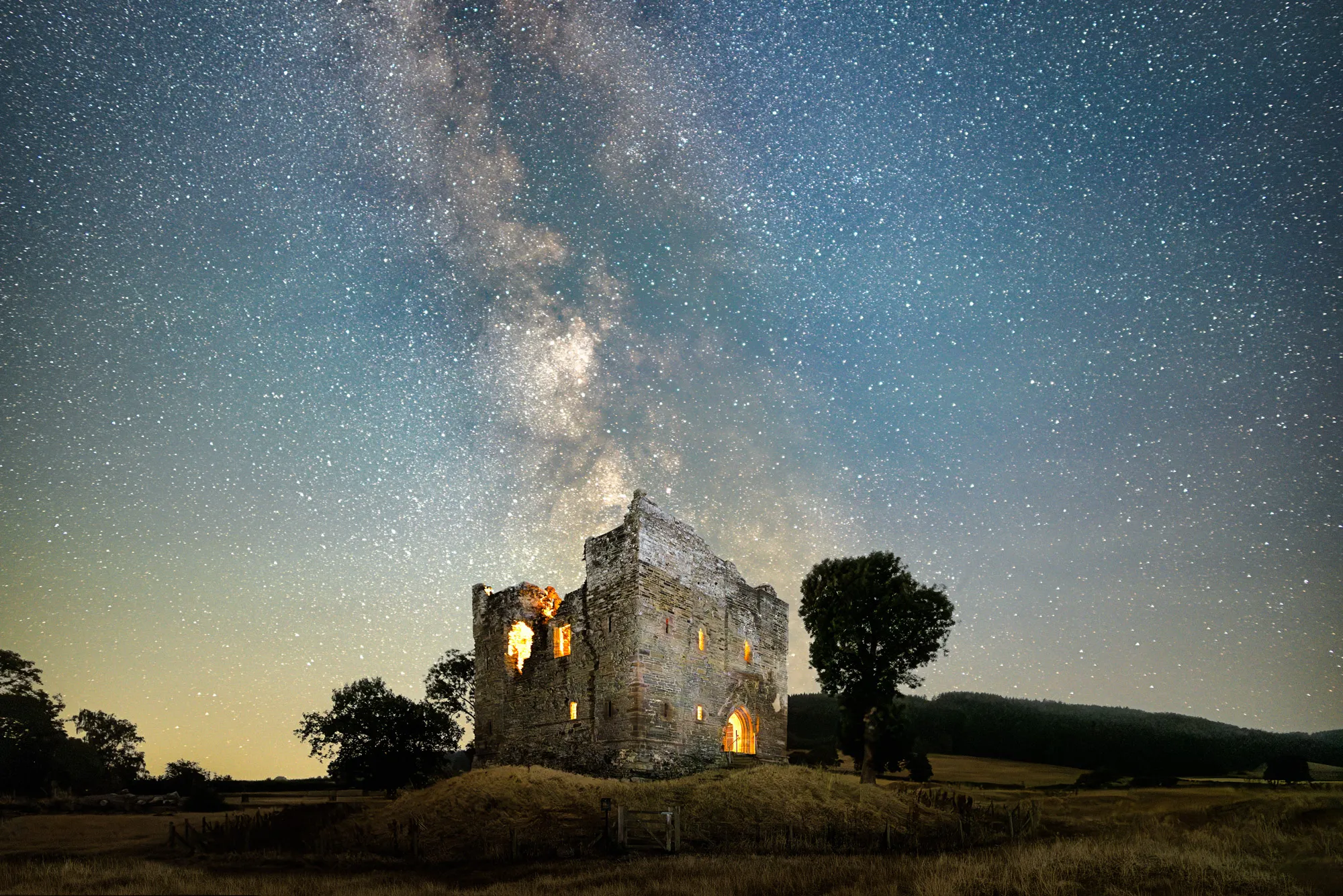
- Hopton Castle
- Canon R5 Mark 2 Camera used:
- Samyang 24mm f1.4 Lens used:
- 14mm Focal length:
- f/4.0 Aperture:
- 120 Sec Exposure time:
- 2500 ISO:
Hopton Castle Under the Stars
A long day, a late-night drive to Shropshire and my first proper attempt at Milky Way photography with the Canon R5 Mark II — made slightly more challenging by forgetting the star tracker and discovering that photographing stars with ageing eyesight isn't quite as straightforward as it used to be.
A First Night Under the Stars with the Canon R5 Mark II
It feels like ages since I'd last been out photographing the Milky Way.
Life has simply been busy over the past few weeks. Between work, everyday commitments and my photography mate Mark settling into retirement, neither of us had managed to get out very much. It had become a little frustrating. Sometimes you don't realise how much you've missed being outdoors with a camera until you're finally loading the car and heading off on another adventure.
This trip had another purpose too. It would be my first real opportunity to see how the Canon R5 Mark II performed for landscape astrophotography.
As many of you know, I've spent years photographing the night sky with the Pentax K-1. It's a camera that has never really let me down, particularly thanks to its incredible Astrotracer feature. In many ways I was slightly apprehensive about moving to Canon.
Older Canon cameras, with the notable exception of the legendary 6D, never really earned a reputation for being outstanding astrophotography cameras, so I wasn't entirely sure what to expect.
To make things even more interesting, I wasn't using native RF glass. Instead, I adapted my trusty Samyang 24mm f/1.4 using a K&F PK-DA to EOS R adapter. Other than checking everything physically fitted together and worked in manual mode, I'd done absolutely no testing beforehand.
What could possibly go wrong?
The destination for the evening was Hopton Castle in Shropshire. This was actually Mark's suggestion. He'd photographed there before, and after recently injuring his knee, wanted somewhere reasonably local without a long walk from the car. Conveniently, he was also keen to test his OM System camera under the stars, making it the perfect excuse for both of us to head out. The journey itself was around 56 miles and took about an hour and a half, leaving home after work before eventually arriving at the castle around 11:30pm. Although I'd researched the location beforehand, my first impression was that it wasn't quite as enclosed as I'd expected from Marks feedback previously.
Despite its tragic history, the place felt incredibly peaceful. There was almost complete silence, broken only by the occasional sound of cattle in neighbouring fields. One thing that surprised me was the complete lack of other photographers. On a clear summer night with the Milky Way visible, I'd expected at least a few people, but we had the entire castle to ourselves.
Even better, the parking couldn't have been easier. The car park is only around twenty metres from the castle itself, with several picnic benches nearby, meaning there was no need to carry every piece of equipment around all night.
Looking back, I couldn't really have made the evening much harder for myself.
Everything was new.
- A new camera.
- An adapted lens.
- A location I'd never photographed before.
And then, just as I unpacked my camera bag...I realised I'd left my star MSM Nomad tracker at home.
Well, that's what happens when you're rushing to pack after work. Normally, with the Pentax K-1's Astrotracer, I'd happily shoot one-minute exposures at ISO 400–800 and come home with beautifully clean files full of detail. Instead, I suddenly found myself having to switch to Plan B.
Without any tracking I was limited to exposures of around 10–13 seconds to avoid star trails, forcing me to raise the ISO much higher than I'd normally choose. It wasn't my preferred workflow, but there wasn't much point getting annoyed. MSM were not going to pull up in the MSM van and hand me a spare tracker, so we laughed about it, adapted, and carried on. Sometimes photography is simply about making the best of the situation you're in. Ironically, the biggest challenge wasn't the camera. It was me.
I'm beginning to notice that my eyesight isn't quite what it used to be, especially at night. Achieving critical focus on stars with a fully manual lens is becoming increasingly difficult. What the camera could see on the rear screen and what my eyes could actually distinguish weren't always the same thing.
Finding perfect focus became a slow process of zooming in, making tiny adjustments, checking, readjusting and hoping I'd nailed it. The Canon menus also took a little getting used to. They're certainly more complicated than the Pentax menu system. While I eventually found everything I needed, I definitely spent longer navigating menus than I'd have liked.
Then there was the tiredness. - I'd been awake since 5am, worked a full day, driven from Bournemouth back home to Worcestershire, unpacked, repacked and then headed straight back out to Shropshire. By the time we started shooting I'd already been awake for well over eighteen hours.
Conditions themselves were pretty good. The weather stayed clear all night, although summer astrophotography always comes with compromises. At this time of year it never gets properly dark, and there was noticeably more light pollution along the horizon than I'd expected.
The Milky Way was visible to the naked eye, but only just. It wasn't one of those spectacular nights where the Galactic Core jumps out of the sky. Instead, it required a little imagination and a lot of help from the camera sensor. Thankfully, the Canon surprised me.
The low-light performance was considerably better than I'd expected. Yes, there was more noise than I'd have seen shooting tracked exposures on the Pentax, but it was perfectly manageable. More importantly, the files contained plenty of detail, giving me confidence that I'd made the right choice moving to the R5 Mark II.
The adapted Samyang lens also worked flawlessly. Manual focus remains challenging, but optically the combination performed exactly as I'd hoped.
Although we'd been photographing throughout the night, neither of us wanted to leave before sunrise. As tired as we both were, there seemed little point driving all that way only to miss the changing light as dawn arrived. Those quiet moments watching the landscape slowly emerge from darkness often become just as memorable as photographing the stars themselves. By the time we packed away, I'd been awake for almost twenty-four hours. It actually took me a couple of days afterwards to feel human again.
Looking back, I came away with an image I'm genuinely pleased with, but perhaps more importantly, I came away with renewed confidence. The Canon R5 Mark II proved itself far better for astrophotography than I'd expected. The adapted Samyang 24mm f/1.4 worked beautifully and Hopton Castle turned out to be a wonderfully peaceful location that I'd happily revisit. Next time, though, I'll make sure I've had a little more sleep...and I'll definitely remember to pack the star tracker. I suspect Hopton Castle would also be absolutely stunning on a misty autumn sunrise. Somehow, I don't think this will be my last visit.
How to get here
Enter your starting location on the box provided under the map to see the route from your starting location to Hopton Castle, Shropshire
Recent Photography Adventures
Why not read about some of my other photography adventures around the UK