
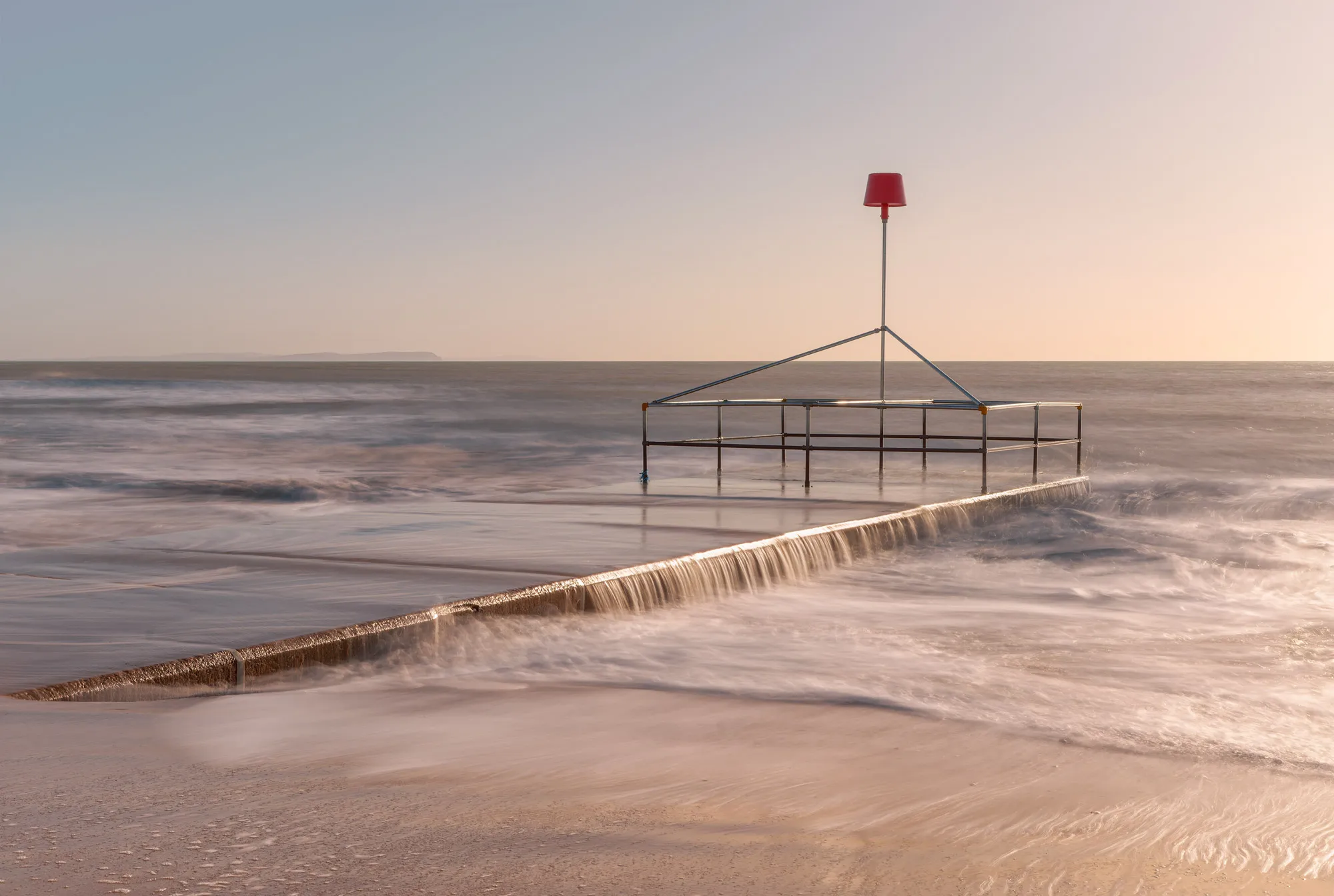
- Beach Apparatus Bournemouth
- Pentax K-1 Camera used:
- Pentax DFA 28-105mm f/3.5-5.6 Lens used:
- 48mm Focal length:
- f/11 Aperture:
- 2.5 Sec Exposure time:
- 100 ISO:
Beach Apparatus - Bournemouth
A rare day without rain, a few hours to spare and a camera in hand — it seemed rude not to head down to Bournemouth beach. What started as a simple chance to get some fresh air and find something interesting to photograph turned into a rather varied few hours, taking me from the movement of the sea and sand to an unexpected piece of beach apparatus, before heading beneath the Wessex Way to explore the architecture and shadows of the Upside Gallery.
Monday before last was a day off work and, more importantly, a chance to spend a few hours at the beach in Bournemouth. The surprising part wasn't actually having a day off — it was that this appeared to be the first day in several weeks when it wasn't raining. So, making the most of the opportunity to get some UV and fresh air, I headed down to the beach with a camera and spent a considerable amount of time wandering around looking for something of note or interest to photograph.
Bournemouth's beach is a pretty impressive stretch of coastline, but photographically it can also feel surprisingly sterile. There's plenty of sand, sea and sky, but finding something that gives you a focal point or tells a story isn't always quite as easy as it might appear. Eventually, I found something.
I'm still not entirely sure what the structure is actually called or precisely what its original purpose was, the structure itself certainly made for a rather more interesting subject than another photograph of an empty beach. The receding tide was crashing over the concrete plinth and metalwork, creating plenty of movement in the water. A soft, warm afternoon light was catching the white water and the leading edge of the concrete, which gave the otherwise rather industrial-looking structure a little more interest.
I was particularly fond of the movement in the water. The way it churns back in on itself before cascading over the edge gives the image a sense of movement that a static structure on its own simply wouldn't have had. Technically, this was shot on my Pentax K-1 at 48mm, using a 2.5-second shutter speed at f/11 and ISO 100. The relatively slow shutter speed was enough to capture the movement in the water without turning it completely into a featureless blur.
And this is probably a good example of why I enjoy wandering around with a camera without necessarily having a specific photograph in mind. I'd gone to the beach simply because I finally had a dry day and wanted to make the most of it. I wasn't looking for this particular structure, and I certainly wasn't expecting it to become the subject of an image. It was simply a case of walking around until something caught my eye.
Looking Down
Later, I took the drone up around sunrise and found another way of looking at the beach.
From above, the shoreline becomes a very different landscape. Rather than concentrating on individual objects, you start to see the patterns created by the sand, the water and the waves as they break across the beach groynes. I spent some time concentrating on the movement of the waves as they rolled over one of the groynes, trying to capture the moment where the water breaks apart and spills across the structure.
The warm sand and greenish-blue sea also produced a lovely colour palette, particularly in the softer light of the morning. It was a completely different photograph from the one I'd taken later in the day, but it came from exactly the same approach — simply looking for something interesting in what might otherwise be an ordinary scene. Bournemouth's beaches are, of course, one of the defining features of the town. The coastline forms part of Poole Bay, with the long sandy frontage backed by the promenade and the familiar series of groynes that help manage the movement of sand along the coast. Groynes have been an important part of the management of the Bournemouth frontage for more than a century, with the first generation of concrete groynes constructed from 1915 onwards. From ground level they're easy to overlook. From the air, however, they become graphic lines cutting through the sand and surf, and suddenly there's a much more interesting photograph waiting to be found.
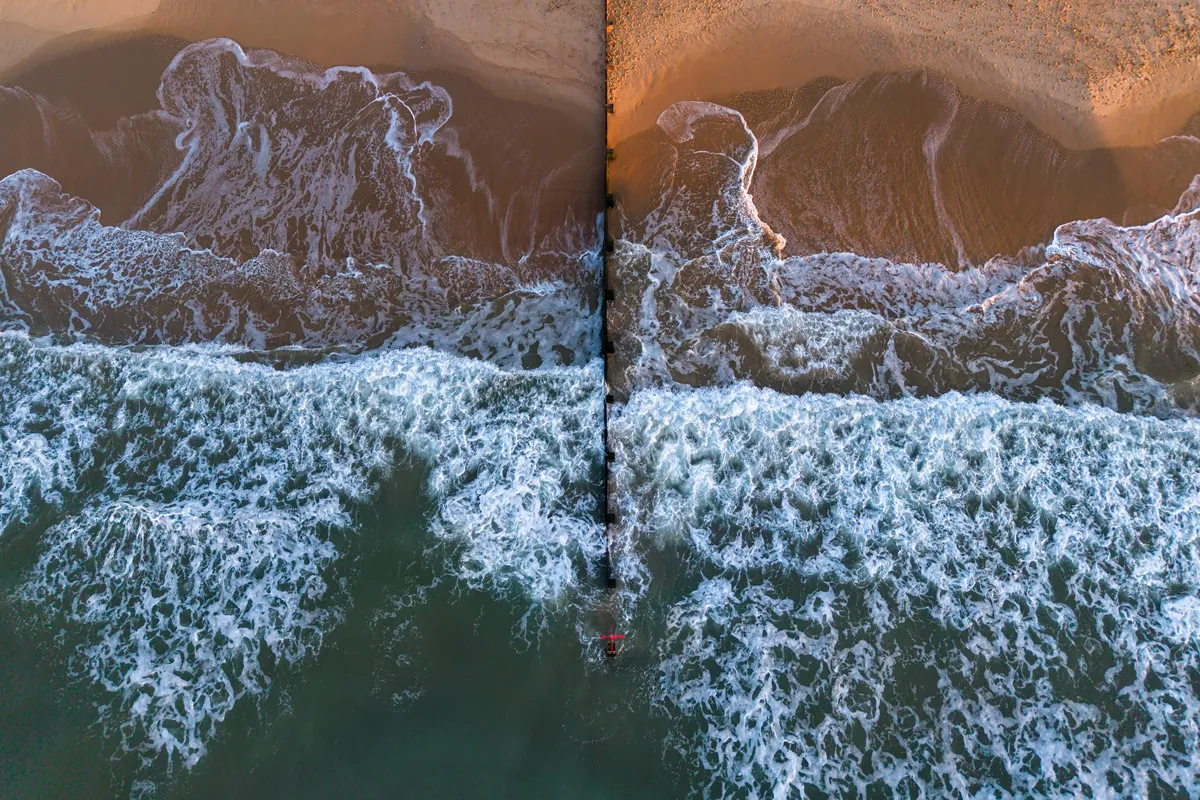
- Breakers
- DJI Mini 5 Pro Camera used:
- DJI 24mm f/1.8 Lens used:
- 24mm Focal length:
- f/1.8 Aperture:
- 1/500th Sec Exposure time:
- 100 ISO:
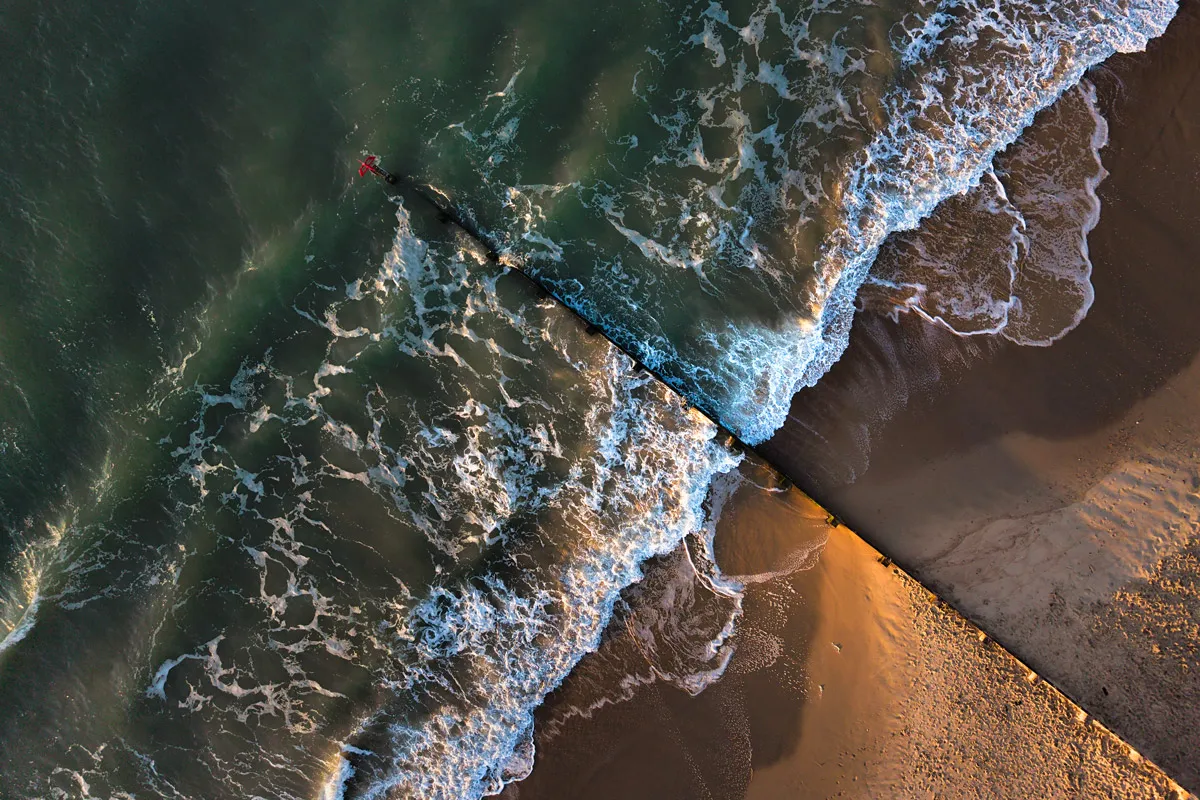
- Breaking Point
- DJI Mini 5 Pro Camera used:
- DJI 24mm f/1.8 Lens used:
- 24mm Focal length:
- f/1.8 Aperture:
- 1/2000th Sec Exposure time:
- 100 ISO:
Looking Up
The beach wasn't the only place I found myself looking at things differently that day.
Away from the sand and sea, I also spent some time underneath the Wessex Way, photographing the underside of the A338 dual carriageway in black and white. It's a completely different sort of landscape.
Instead of looking for natural light, waves and movement, I was looking at concrete, steel, shadows and the repeating geometric shapes created by the structure. Removing the colour seemed the obvious choice. Without the distraction of the blue sky, green sea and warm sand, the attention shifts towards the architecture and the way the light falls across it.
The Wessex Way cuts through Bournemouth's Central Gardens, with the flyover dating from the 1970s. What might otherwise be regarded simply as a piece of transport infrastructure has, somewhat unexpectedly, become a backdrop for something much more creative. Underneath it is the Upside Gallery, an outdoor street-art gallery occupying the concrete spaces beneath the flyover. The project transformed what was once a rather uninspiring stretch of concrete into a collection of large-scale murals by eleven UK artists.
I wasn't particularly interested in photographing the murals themselves on this occasion. Instead, I found myself drawn to everything around them — the structure of the flyover, the columns, the shadows and the way the available light created strong contrasts across the concrete. It's funny how a day that started with me simply trying to find something worth photographing on a beach ended up producing three quite different photographic subjects. The sea, the structures and the architecture.
Perhaps that's one of the best things about not having a particular shot in mind when you head out with the camera. You don't necessarily know what you're looking for until you find it.
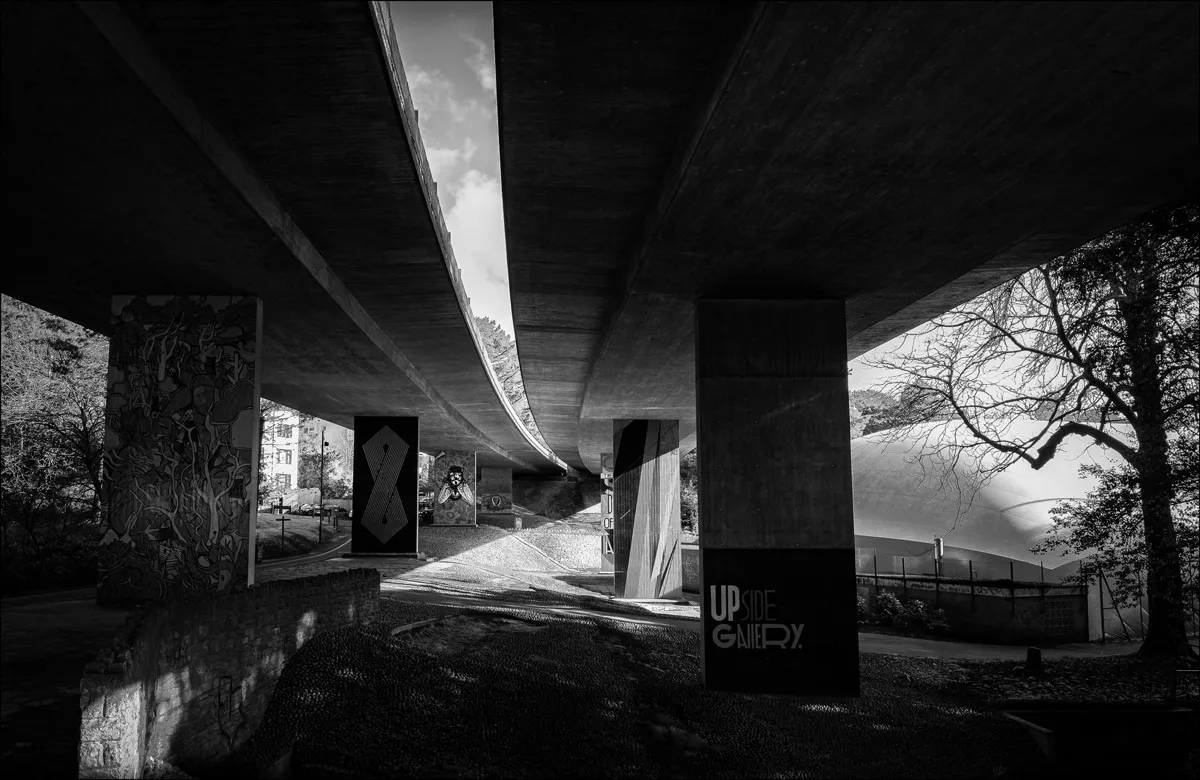
- Fly On The Wall
- Pentax K-1 Camera used:
- Pentax-D FA 21mm f/2.4 ED Ltd Lens used:
- 21mm Focal length:
- f/11 Aperture:
- 1/15th Sec Exposure time:
- 100 ISO:
How to get here
Enter your starting location on the box provided under the map to see the route from your starting location to Bournemouth Beach
Recent Photography Adventures
Why not read about some of my other photography adventures around the UK